

10x National Security Open-Sources Nexus AI Gateway - an AI Router to enable Enterprise AI Adoption

Nexus Logo
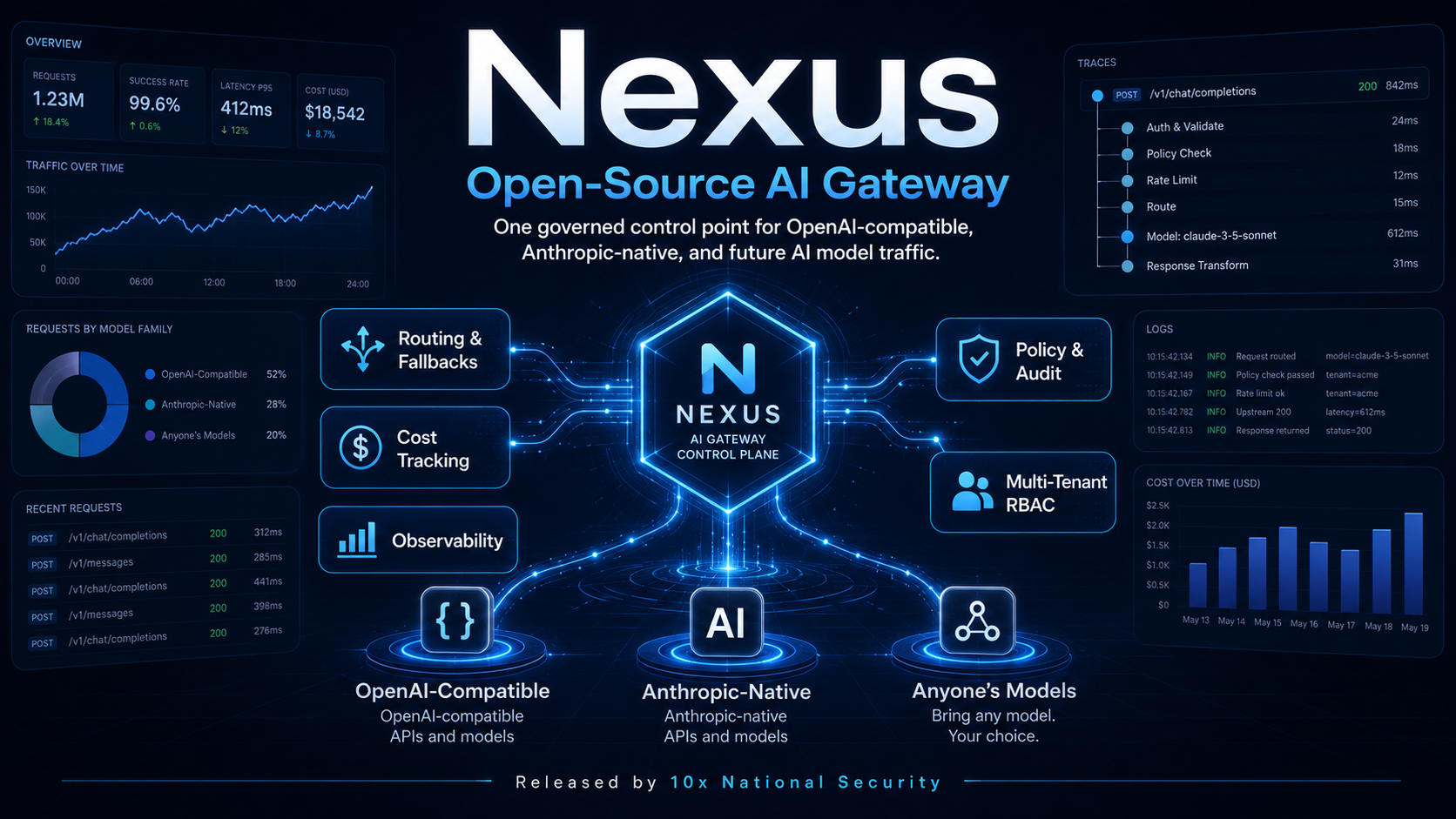
Nexus AI Gateway
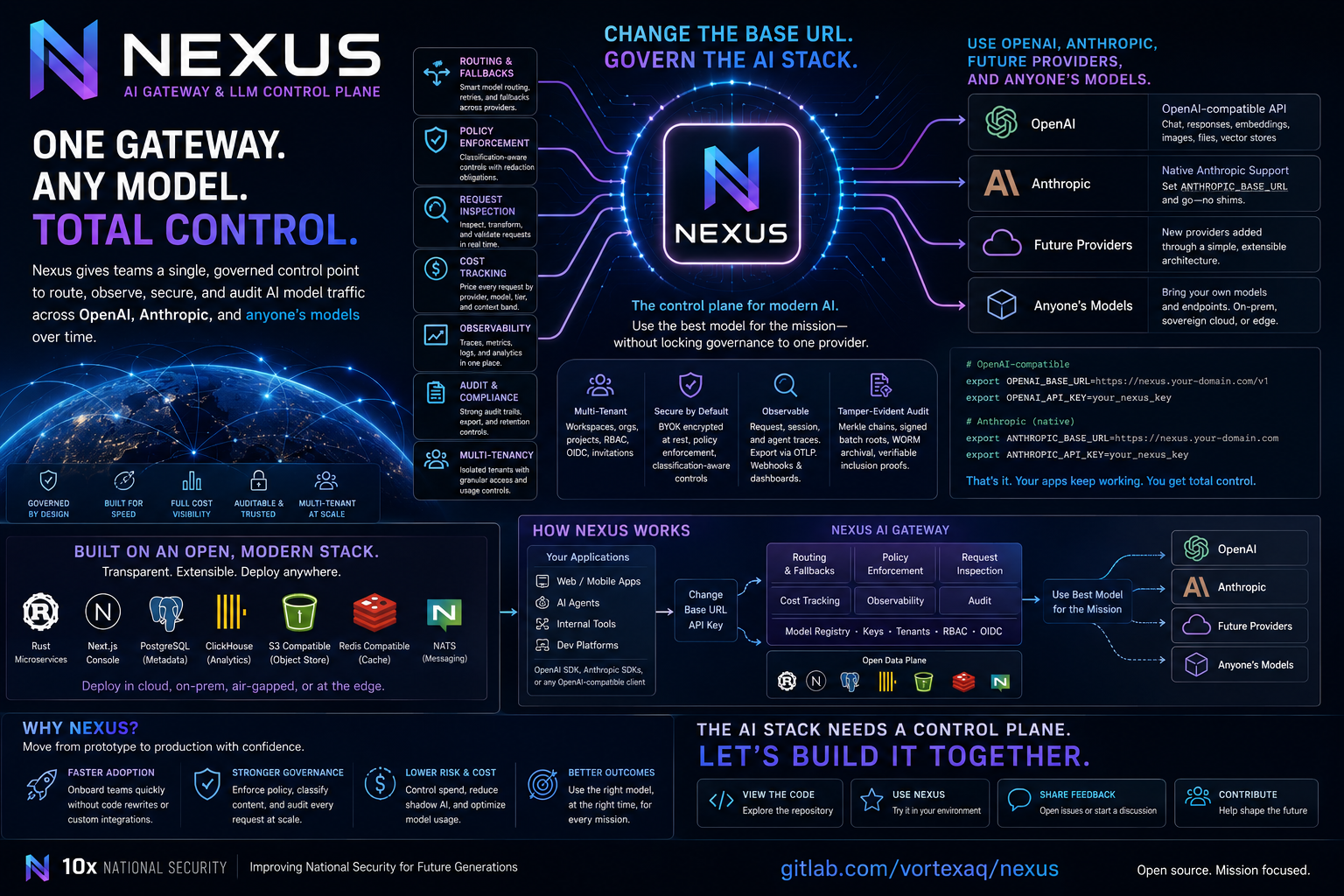
Nexus AI Gateway Details
Nexus gives teams one governed control point to route, observe, audit, and manage OpenAI, Anthropic, and anyone’s models over time.
MANASSAS, VA, UNITED STATES, July 8, 2026 /EINPresswire.com/ -- 10x National Security today announced the open-source release of Nexus, an artificial intelligence (AI) gateway and Large Language Model (LLM) control plane designed to help organizations adopt AI faster while maintaining control over model access, cost, policy, observability, and audit.
Nexus gives developers and platform teams a single, multi-tenant control point in front of LLM providers. Applications can continue using OpenAI-compatible APIs or native Anthropic SDKs, allowing teams to begin routing AI traffic through Nexus by changing a base URL and API key rather than rewriting application code.
The project is available now at https://gitlab.com/vortexaq/nexus.
“AI adoption is moving faster than most organizations’ governance models,” said John Eubank IV, Founder and CEO of 10x National Security. “Teams are experimenting with models, agents, copilots, and AI applications across the enterprise, but too often they are doing it through direct provider calls, scattered API keys, disconnected logs, limited cost visibility, and fragmented policy enforcement. Nexus gives developers the speed they need while giving operators, security teams, and mission leaders the control point they need.”
Nexus currently supports OpenAI and Anthropic through a unified gateway model. Its OpenAI-compatible API supports chat, responses, embeddings, images, files, and vector stores. Nexus also includes native Anthropic support, allowing Anthropic SDKs and Claude Code to work by setting ANTHROPIC_BASE_URL, with no translation shims required in application code.
The goal is to let organizations use the models that best fit the mission without locking governance, observability, cost management, or auditability to a single provider. Nexus is designed to support OpenAI, Anthropic, future providers, and anyone’s models over time as integrations are added by 10x National Security and the open-source community.
For developers, Nexus is intended to reduce friction. Existing applications can keep familiar client libraries and protocols while gaining a governed access layer for AI traffic. For platform teams, Nexus creates a common operating point for routing, provider credentials, request inspection, telemetry, and policy. For security and compliance teams, Nexus provides a place to enforce controls before requests reach external or internal model providers.
Nexus includes routing and fallback capabilities that allow teams to select models using a provider/model grammar, retry failed requests, fall back across alternate providers and models, and optionally cache responses. This allows organizations to improve resilience, manage provider availability, and experiment with different models without forcing every application team to build its own routing logic.
Nexus also supports bring-your-own-key workflows. Tenants can register their own provider keys, encrypted at rest, while operators can add managed credentials with wallet-based billing. This gives organizations flexibility in how they allocate usage, manage provider accounts, and separate tenant activity in shared environments.
Cost tracking is built into the platform. Every request can be priced by provider, model, service tier, and context band using a live model registry. This gives teams better visibility into which applications, tenants, projects, models, and usage patterns are driving AI costs. As AI adoption expands, that visibility becomes critical for budgeting, chargeback, optimization, and executive decision-making.
Observability is another core capability. Nexus allows teams to inspect requests, sessions, and agent traces in the console, export traces through OTLP, and integrate with webhooks and existing monitoring pipelines. This helps teams understand how AI systems are being used, where failures occur, which models are selected, how fallback paths behave, and how agentic workflows perform across real applications.
For governed environments, Nexus includes classification-aware policy controls. A nexus-classification header is enforced against a per-request classification ceiling, with redaction obligations. These capabilities are intended to help organizations build AI systems with stronger policy enforcement, clearer accountability, and better separation between application behavior and model-provider behavior.
Nexus also includes tamper-evident audit capabilities using per-tenant Merkle chains, signed batch roots, WORM archival, and verifiable inclusion proofs. These features are designed to help organizations preserve stronger evidence of AI activity, support review workflows, and improve trust in shared, multi-tenant AI environments.
The platform is built for multi-tenant operation, with workspaces, organizations, projects, role-based access control, invitations, and OIDC sign-in. This allows Nexus to support teams, programs, customers, business units, and mission environments through a common control plane while maintaining tenant separation and access governance.
Nexus is implemented as Rust microservices with a Next.js console on a fully open-source data plane that includes Postgres, ClickHouse, S3-compatible object storage, NATS, and a Redis-compatible cache. The architecture is intended to be transparent, inspectable, extensible, and deployable by teams that want control over their AI infrastructure.
“Nexus is built around a practical idea: AI applications should not have to be rewritten every time an organization changes providers, policies, models, or deployment patterns,” Eubank said. “The gateway becomes the control point. Developers keep building. Organizations gain governance, cost visibility, auditability, and the freedom to use the models that best fit the mission.”
10x National Security is releasing Nexus as open source because governed AI adoption is a shared challenge across industry, government, critical infrastructure, and the developer community. Organizations need AI systems that can move quickly from prototype to production without creating uncontrolled sprawl. Open source gives users the ability to inspect the code, test the architecture, shape the roadmap, and contribute integrations that matter to their missions.
10x National Security is inviting contributors, users, and technical feedback from AI application developers, platform engineers, security engineers, government integrators, DevSecOps teams, data platform teams, and organizations building production AI systems.
Priority contribution areas include provider integrations, deployment examples, OpenTelemetry integrations, policy examples, model registry improvements, SDK compatibility testing, documentation, UI and user experience improvements, security hardening, local development workflows, Helm and Terraform examples, and real-world use cases.
Developers can view the repository, try Nexus, submit issues, and contribute at https://gitlab.com/vortexaq/nexus.
About 10x National Security
10x National Security builds mission software, AI systems, secure platforms, and advanced technology capabilities. The company focuses on delivering production-ready systems that improve speed, trust, interoperability, and mission impact.
Brian Knobbs
10x National Security
BD@10xnatsec.com
Legal Disclaimer:
EIN Presswire provides this news content "as is" without warranty of any kind. We do not accept any responsibility or liability for the accuracy, content, images, videos, licenses, completeness, legality, or reliability of the information contained in this article. If you have any complaints or copyright issues related to this article, kindly contact the author above.
